Jubilee Hills, Hyderabad
 Tradition, Technology, Transformation


27 November 2026
Why Creativity and Innovation Are Important in a Child's Learning Journey
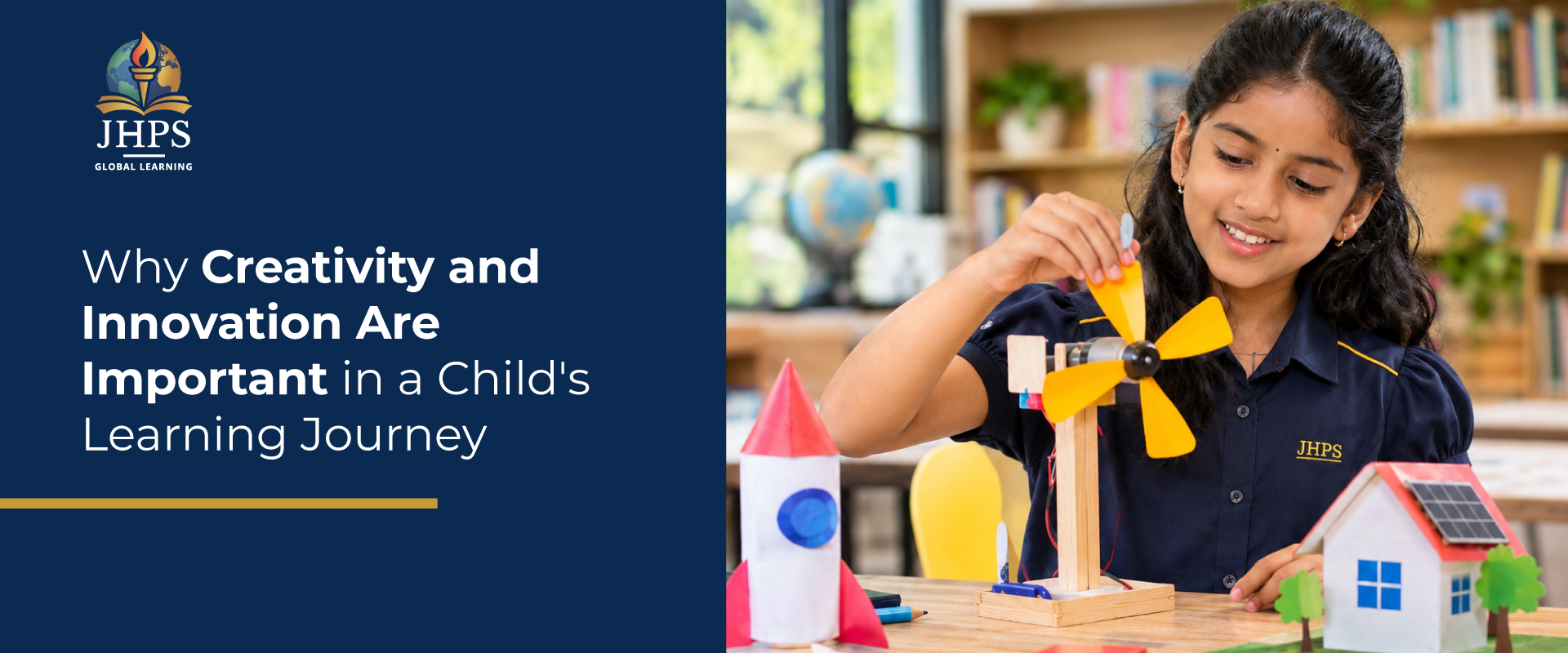
Children have a funny way of looking at things. Give them a cardboard box, and they might turn it into a house, a car, or something nobody else can quite figure out. Give them a question, and sometimes the answer they come up with is completely unexpected. These little moments say a lot about how children learn.
Learning is not always about remembering what a teacher has explained. A child also needs the chance to try things, make mistakes and come up with ideas independently. This is where creativity and innovation become important. They bring a different kind of experience into the classroom, one where children are doing more than just listening and following instructions.
Learning Becomes Interesting When Children Can Look At
Think about the difference between telling a child how a paper boat floats and actually giving them paper to make one. The second experience is likely to stay with them longer. They get to fold the paper, put it in water and see what happens.
That is the simple idea behind creative learning. Children understand things differently when they are allowed to take part in the process. They become curious about what they are doing, and one question often leads to another.
Not every activity needs a big plan either. Sometimes, a classroom conversation, a small experiment or an unusual question is enough to get children thinking.
Children Need Space To Find Their Own Answers
There is a tendency to help children as soon as they seem stuck. It comes from a good place, of course, but solving every little problem for them does not leave much room for independent thinking.
Imagine a child trying to put together a puzzle. The pieces do not fit, so they turn them around, try another place and perhaps get a little frustrated. Eventually, something clicks.
These ordinary experiences help develop problem-solving abilities. Children slowly understand that there may be several ways to approach a situation. They also learn that getting something wrong is not such a big deal.
At JHPS Global Learning, we encourage children to ask questions, understand possibilities and take an active part in their learning rather than simply depend on ready-made answers.
Art Gives Children Another Way To Express Themselves
Not every child is comfortable explaining everything in words. Some find it easier to show what they are thinking through colours, shapes and pictures. This is one reason creative activities deserve a proper place in school.
Simple things like decorations, painting or floor art can become interesting learning experiences. Children experiment with colours, notice patterns and decide how they want their work to look.
And the result does not have to be perfect. A drawing with uneven lines or a craft project that looks a little different from the original idea is still worth appreciating. The child has made something independently, and that matters.
Stories Can Make Even Difficult Ideas Easier
Children often remember a story long after they have forgotten a classroom explanation. Perhaps it is the character they liked or the funny thing that happened halfway through. Either way, stories give them something to connect with.
Using storytelling for learning can make unfamiliar subjects feel less difficult. A story about animals, for example, can lead to questions about their homes, food and surroundings.
Children can also make up their own endings, imagine different characters or explain what they would have done in a particular situation. These activities give them a chance to use their imagination without feeling that there is only one correct response.
Innovation Is Not Just About Technology
When innovation comes up in education, it is easy to think about computers, robots and complicated machines. They certainly have a place, but innovation can begin with something much smaller.
A child finding a different way to build a tower or thinking of a new use for an everyday object is also looking at an idea. These experiences help children develop creative skills that they can use in many situations.
Introducing new learning through practical activities makes this easier. STEM experiments, basic robotics, model-making and hands-on science activities allow children to see what happens when an idea is put into practice.
They may not get everything right on the first attempt. That is perfectly fine. Sometimes, the second or third attempt is where the interesting part begins.
A School Environment That Makes Room For Creativity
Children need more than occasional creative activities. They need an environment where asking questions, trying something different and expressing an opinion feel like normal parts of the school day. Teachers play a big role here. A little encouragement can make a child who rarely speaks up more comfortable sharing an idea. Access to different learning spaces and resources also gives children more ways to discover what they enjoy.
How We At JHPS Global Learning Encourage Creative Thinking
At JHPS Global Learning, we believe education should leave room for curiosity, not just classroom lessons and examinations. Through our Cambridge Early Years and Cambridge Primary Years programmes, we encourage children to explore, participate and develop their own understanding of different subjects. We bring practical experiences into learning through our STEM and Robotics Labs, dedicated Space Lab and Maker's Lab.
The art space provided by our school helps them develop interests in areas other than academics. It is also essential for us to understand that each learner has their own unique learning style; hence, individual attention plays an important role. Our learners need to be encouraged to ask questions and express themselves freely. For us, preparation for the future not only includes making them capable individuals but also independent thinkers.
Creativity Should Not Be Measured By Perfect Results
A child who enjoys painting may not necessarily enjoy building models. Another might be more interested in asking questions about how things work. Both are showing creativity in their own ways.
It is easy to compare children, especially when some seem quicker at certain activities than others. But creative development does not follow one timetable. Some children need more time to open up, while others are happy to share every idea that comes to mind.
What matters is that they get the opportunity. When children feel that their ideas are welcome, they become more willing to experiment and take part.
Final Thoughts
A child's learning journey should have room for more than lessons, homework and correct answers. There should be time for drawing something unusual, asking questions that seem unrelated and trying an idea that may or may not work. These experiences are not distractions from education. They are part of it. Creativity and innovation help children discover how they think, what interests them and how they can approach different situations. And sometimes, the most meaningful learning happens when a child is simply given the freedom to try. Fostering creativity in children opens up endless possibilities for their cognitive and emotional development.
Frequently Asked Questions
Why is creativity important for learning?
Creative learning builds creative skills that help learners understand deeply, remember longer, and apply knowledge to solve new problems.
How does creativity contribute to early childhood development?
Creativity in children drives early development by encouraging new learning, building problem-solving, language, emotional, and social skills through play, exploration, and imagination.
What are the three main types of creativity?
The three main types of creativity are deliberate, spontaneous, and flow.
How does creativity help a child's learning journey?
Creativity helps children think flexibly, solve problems, express ideas, and understand concepts more deeply, which makes learning more engaging and memorable.
How can parents encourage creativity and innovation in children at home?
Parents can nurture creativity by giving kids time to play freely, explore materials, and share their own ideas without fear of being wrong.
Related Blogs

27 November 2026
How Cambridge Schools Balance Academic Excellence with Extracurricular ActivitiesContinue Reading

16 October 2026
Admission Process For Cambridge Schools In Hyderabad: Age Criteria, Documents, And TimelineContinue Reading